
Aviation Antenna Guide
Complete guide to antennas for Stratux and DIY aviation receivers. Learn about different frequencies, antenna gain, and why low-gain omnidirectional antennas are optimal for traffic awareness in the cockpit.
Aviation Frequencies & Antenna Types
Different aviation protocols operate on specific frequencies, each requiring appropriately tuned antennas. Here's a breakdown of what you need:
1090 MHz - ADS-B (Mode S Extended Squitter)
ADS-B, Mode A/C/S
The global standard for commercial aviation. ADS-B signals from airliners, jets, and Mode S-equipped aircraft are broadcast on 1090 MHz. This is the primary frequency for receiving traffic from high-altitude IFR aircraft.
978 MHz - ADS-B UAT (Universal Access Transceiver)
UAT (978 MHz)
UAT is a US-only alternative to 1090ES, used primarily by general aviation aircraft flying below FL180. It also provides FIS-B weather data. European pilots do not need UAT antennas-978 MHz is not used in Europe.
868 MHz - 868 MHz ISM Band (Europe)
FLARM, OGN, ADS-L, FANET, PilotAware
The 868 MHz ISM band is used by multiple aviation protocols in Europe: FLARM (glider collision avoidance), OGN (Open Glider Network tracking), ADS-L (low-altitude drones and light aircraft), FANET (paragliding mesh network), and PilotAware (UK conspicuity). A single 868 MHz antenna can receive all these protocols simultaneously with dual-band SDR receivers.
162 MHz - Marine AIS (Automatic Identification System)
AIS
AIS operates on 161.975 MHz and 162.025 MHz, providing ship positions, course, and speed. Stratux can optionally receive AIS using a third NooElec Nano SDR with a VHF antenna. This is particularly useful for pilots flying coastal routes or over water, as boats and ships become visible on your EFB app alongside aircraft traffic.
Understanding Antenna Gain
Antenna gain is often misunderstood in aviation applications. While high-gain antennas might seem desirable, low-gain omnidirectional antennas are actually optimal for cockpit traffic receivers.
Why Low Gain is Better for Stratux
360° Reception Coverage
Low-gain antennas (0-3 dBi) provide near-omnidirectional coverage, receiving signals from all directions equally. High-gain antennas focus energy in a narrow beam, creating blind spots above and below-exactly where traffic might be.
Aircraft Attitude Independence
During turns, climbs, and descents, your aircraft's attitude constantly changes. A low-gain antenna maintains reception regardless of bank angle or pitch, while a directional antenna would lose signals as you maneuver.
No Need for Long Range TX
For OGN/FLARM transmission, you don't need to broadcast hundreds of nautical miles. The purpose is to be visible to nearby traffic within 5-20 km-the typical FLARM collision warning range. Low-gain antennas provide exactly this coverage pattern.
Compact & Cockpit-Friendly
Low-gain antennas are typically shorter and more compact, making them easier to mount on the glareshield or window. High-gain antennas require precise vertical orientation and are impractical for portable use.
Antenna Gain Comparison
Antenna Gain Comparison
| Gain Type | Radiation Pattern | Best Use Case |
|---|---|---|
| Low-gain (0-3 dBi)Recommended | Near-omnidirectional (donut shape) | Stratux, portable receivers |
| Medium-gain (4-6 dBi) | Flattened pattern, reduced vertical coverage | Fixed ground stations |
| High-gain (7+ dBi) | Narrow beam, significant blind spots | Long-range ground tracking only |
Directional Antennas for Bearing Accuracy
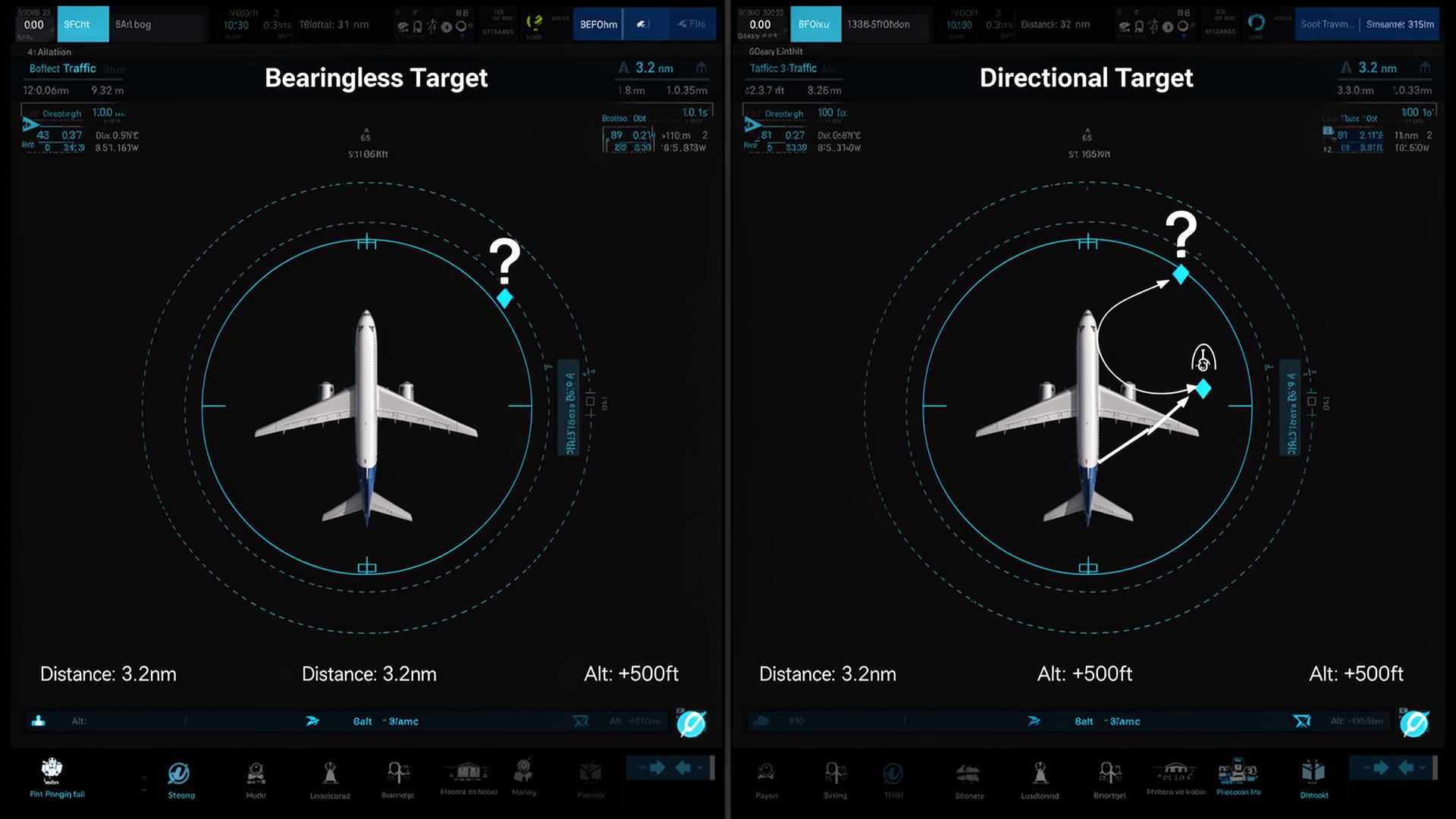
While low-gain omnidirectional antennas are ideal for portable traffic receivers, directional antenna arrays are used by ground stations and some advanced systems to determine the bearing (direction) to transmitting aircraft. Understanding this distinction helps explain why some targets appear as 'bearingless' on your EFB.
How Bearing Calculation Works
GPS Position (Primary)
Most ADS-B and FLARM targets broadcast their GPS coordinates. Your EFB calculates the bearing by comparing the target's position to your own GPS location. This is the most accurate method and produces 'directional targets' with bearing arrows.
Antenna Arrays (Ground Stations)
Ground-based receivers like OGN stations use multiple directional antennas or phased arrays to triangulate signal direction. By measuring signal strength or phase differences across antennas, they can determine bearing even for Mode A/C transponders that don't broadcast position.
MLAT (Multilateration)
Networks of ground receivers can calculate aircraft position by measuring tiny differences in signal arrival time (TDOA). This calculated position is then forwarded to your receiver, allowing bearing display for otherwise position-less targets.
Why Some Targets Are Bearingless
Bearingless targets (range-only or non-directional targets) appear when your receiver knows an aircraft exists and its approximate distance, but cannot determine the direction. This happens because:
Standard Stratux receivers with single omnidirectional antennas rely on GPS position broadcast for bearing. For Mode A/C targets, MLAT data from OGN or other networks can provide calculated positions. See our ADS-B guide for more on bearingless targets.
Antenna Mounting: Vertical is Critical
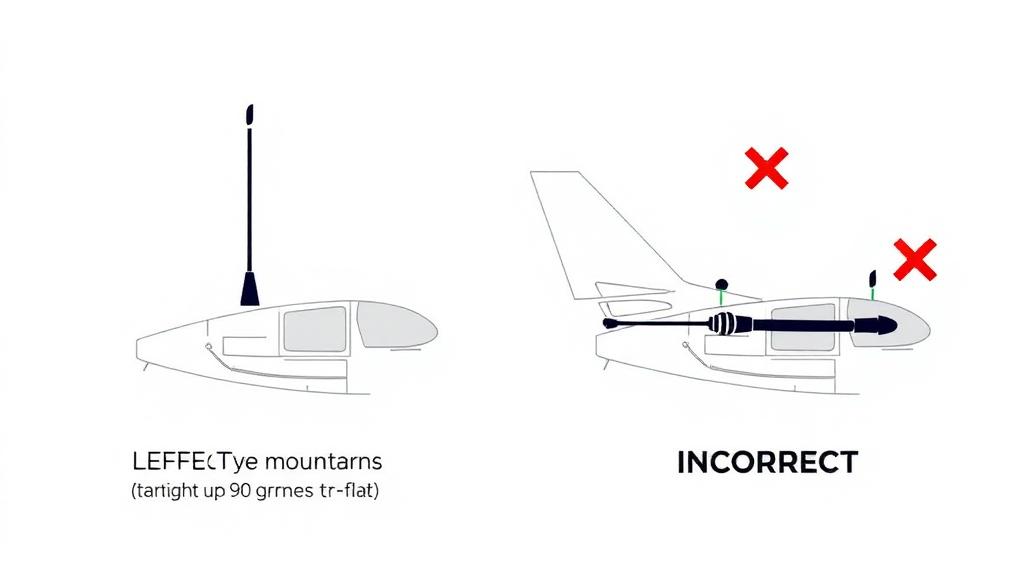
Proper antenna orientation is essential for optimal signal reception. All aviation antennas must be mounted vertically (90° perpendicular to the ground).
Why Vertical?
Aviation signals (ADS-B, FLARM, OGN) use vertical polarization. A vertically mounted antenna aligns with this polarization for maximum signal capture.
Signal Loss from Wrong Orientation
A horizontally mounted antenna can lose up to 20 dB of signal strength-reducing your effective reception range by 90% or more.
Window Mount Tip
When using a suction cup mount, ensure the antenna points straight up, not angled with the windscreen slope. Adjust the mount angle to achieve true vertical.
Coax Cable Selection (GPS / 868 / 1090 MHz)
All Dross:Aviation antennas and SDR receivers use standard SMA connectors. GPS L1 (1575 MHz), 868 MHz (FLARM/OGN/ADS-L) and 1090 MHz (ADS-B) are all UHF/L-band signals where thin coax gets lossy quickly, so the right cable is driven almost entirely by run length. Use this table to pick the coax that feeds your SDRs via SMA.
| Run Length | Recommended Cable | Approx. Loss @ 1 GHz | Why |
|---|---|---|---|
| Short (< 1–1.5 m)Recommended | RG-316 (preferred), or RG-174 | RG-316 ≈ 0.9 dB/m · RG-174 ≈ 1.1 dB/m | Best all-round cockpit pigtail. RG-316 matches RG-174's thin, flexible ~2.5 mm form but uses a PTFE dielectric (heat- and abrasion-resistant), has slightly lower loss, and crimps cleanly into SMA. |
| Medium (1.5–3 m) | RG-400 / RG-142 or LMR-240 | ≈ 0.24–0.45 dB/m | At these lengths RG-316/174 loss becomes unacceptable at 1090 MHz and GPS L1. Step up to a low-loss line. RG-400 is the rugged double-shielded PTFE choice; LMR-240 is the lowest loss if you accept the stiffness. |
| Avoid | RG-178 · RG-58 (only if unavoidable) | RG-178 ≈ 1.5–2 dB/m | RG-178 is too lossy for L-band. RG-58 is workable but stiff, and its PE dielectric tolerates cockpit heat poorly. Both are second-best to RG-316. |
- Connectors: SMA-male into the SDR's SMA-female, finger-tight only (do not over-tighten). Each connector or adapter adds ~0.3–0.5 dB. Minimize barrels and adapters.
- One cable type covers all three: 868 and 1090 MHz are nearly identical electrically, and GPS L1 is the same family with ~25% more loss per metre, so let GPS set your length budget. RG-316 is a great default house cable for everything.
- GPS caveat: in a standard Stratux the GPS does not connect to an SDR. It comes from a USB receiver or the T-Beam module. Only an external GPS antenna uses an SMA coax feed, and it must be an active (LNA-powered) antenna kept as short as possible.
- Keep total cable length under ~2 m. RG-316 at 1.5 m ≈ 1.4 dB at 1090 MHz / ~1.7 dB at GPS L1, acceptable; beyond that, switch to the low-loss tier rather than accepting the loss.
Bottom line: standardize on RG-316 with SMA-male connectors for short cockpit runs across GPS, 868 and 1090 MHz. Move up to RG-400/RG-142 or LMR-240 only when a run exceeds ~1.5 m, and ensure any external GPS antenna is an active type kept as short as possible.
RF Connector Types & Frequency Limits
Coax connectors each have an upper frequency limit set by their mechanical design. Aviation SDR signals sit at GPS L1 (1575 MHz), 868 MHz and 1090 MHz, so any connector rated to at least ~2 GHz works electrically — but Dross:Aviation standardizes on SMA because it is compact, threaded, and rated far beyond these bands. The chart below compares the common interface types and their upper frequency limits.
SMA is the standard interface on all Dross:Aviation antennas and SDR receivers — rated to 18 GHz, it has enormous headroom over the 868 / 1090 / 1575 MHz aviation bands.
Antenna Product Comparison
Find the right antenna for your frequency requirements. Our product lineup covers all major aviation protocols.
| Frequency | Protocols | Region | Gain | Recommended Product |
|---|---|---|---|---|
1090 MHz | ADS-B, Mode S | Essential | 2 dBi | 1090 MHz Stub Antenna |
868 MHz | FLARM, OGN, ADS-L, FANET, PAW | Europe | 2.5 dBi | 868 MHz Stub Antenna |
868 MHz + GPS | FLARM, OGN, ADS-L, FANET, PAW + GPS | Best Value | 2 dBi | 2-in-1 Antenna (868 MHz + GPS) |
978 MHz | UAT (FIS-B weather) | US Only | 2 dBi | 978 MHz UAT Antenna |
162 MHz | Marine AIS | Optional | 3 dBi | VHF Marine Antenna |
All antennas use standard SMA connectors for universal SDR compatibility.
Dross:Aviation Custom 2-in-1 Antenna
We've developed a custom-made low-gain antenna solution specifically optimized for Stratux cockpit use. Our 2-in-1 antenna combines 868 MHz reception with integrated GPS-reducing antenna clutter and simplifying installation for FLARM/OGN protocols.
- 868 MHz reception for FLARM, OGN, ADS-L, FANET, PAW
- Integrated ceramic GPS antenna-no separate GPS puck needed
- Low-gain omnidirectional pattern for 360° coverage
- Compact form factor-minimizes cockpit clutter
- Suction cup mount available for window mounting
- SMA connectors for universal compatibility
⚠️ Critical: Always mount vertically (90° to horizontal) for proper signal reception.
Marine AIS for Coastal Flying
For pilots flying coastal routes or near maritime traffic, Stratux can optionally receive Marine AIS signals, displaying boats and ships on your EFB app alongside aircraft traffic. This feature is particularly valuable for seaplane operations, coastal VFR routes, and flying over shipping lanes.
AIS Setup Requirements
- Third NooElec Nano SDR (in addition to dual SDRs for ADS-B/FLARM)
- VHF marine antenna tuned for 162 MHz
- EFB app with AIS traffic display support (SkyDemon, ForeFlight, etc.)
AIS Frequencies
AIS reception adds situational awareness for maritime traffic but does not replace proper navigation procedures when flying over water. Always file appropriate flight plans and carry required safety equipment for overwater operations. Learn about EFB app compatibility →
Antenna FAQ
Related Technology Guides
Find the Right Antenna
Browse our selection of optimized antennas for Stratux, or explore our complete antenna category for all available options.
Disclaimer
Stratux is not certified aviation equipment. It does not replace a transponder or relieve the pilot of traffic awareness responsibilities. Use as supplementary situational awareness only. Dross:Aviation assumes no responsibility or liability for the use of Stratux devices, firmware flashing, or hardware modifications. All DIY guides are provided without warranty-use at your own risk.